
Download KMSPico application for MS Windows and MS Office activation
Information About KMSPico
| 📝 Description | Activation of Windows and Office without keys |

|
|---|---|---|
| 🔖 Version | 11.2.1 [update 2026] | |
| 🌍 Supported Languages | English | |
| 💾 Disk Requirements | 150 MB of free space | |
| 🖥️ Operating System | Windows 7, 8, 10, 11 [32/64 bit] | |
| 📥 Number of Downloads | 1,253,874 |
Important Information
Archive Requirements
To open the downloaded archive, you will need WinRAR archiver software.
Archive Password
The password for the archive is: 2026
Before Activation: Disable Antivirus
Temporarily disable your antivirus (including Windows Defender) to ensure successful activation.
Antivirus may mistakenly block activation tools
Re-enable protection immediately after activation
Common practice for all software activation methods
Prevents activation failures and errors
Don't worry: This is completely safe. The files are secure, but antivirus programs are cautious with activation tools.
What is KMSPico and Why is it Needed?
If you want to activate Microsoft Windows or Microsoft Office without a license key, then the KMSpico program is what you need. The program is distributed free of charge. The program was created by the Team Day development team. With this activator, you can activate Windows 11, 10, 8, 7 and Microsoft Office. 2021, 2019, 2016, 2013, 2011. Activation is performed for an unlimited period or for 180 days.

Why Choose KMSPico?
- Works with Windows 7, 8, 10, 11 and Office 2010–2021
- No keys or internet required
- One click — and activation is ready
- Supports updates and PC restarts
🖥️ Supported Windows and Office Versions
KMSPico supports activation for the following versions of Windows and Microsoft Office. ✅ All versions are fully compatible and can be activated with a single click.
| # | Product | Supported Versions |
|---|---|---|
| 1 | Windows 7 | All editions (Home, Pro, Ultimate) |
| 2 | Windows 8 | All editions (Standard, Pro, Enterprise) |
| 3 | Windows 8.1 | All editions (Standard, Pro, Enterprise) |
| 4 | Windows 10 | All editions (Home, Pro, Enterprise, Education) |
| 5 | Windows 11 | All editions (Home, Pro, Enterprise, Education) |
| 6 | Microsoft Office | 2010, 2013, 2016, 2019, 2021, and Microsoft 365 |
How to Download KMSPico Safely?
The activator should only be downloaded from trusted sources. Always check files after downloading. If you doubt the trustworthiness of the source, it is better to read the reviews. Below are the Kmspico download links from the trusted source. You need to click on the link and the archive file will be in your download folder.
How to Use KMSPico?
- 🛡️ Disable Windows protection (otherwise, files will be blocked).
- 📂 Extract the downloaded archive (password: 2026).
- 👨💻 Run KMSPico.exe as administrator.
- 🖱️ Click on the Windows or Office icon.
- ⏳ Wait for the activation confirmation.
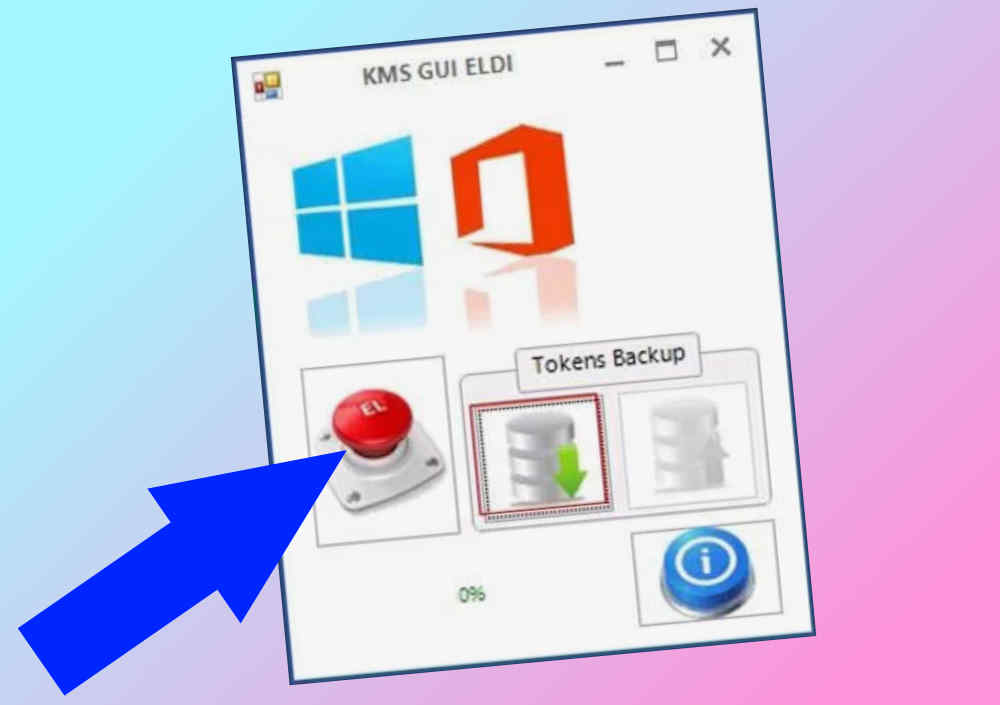
The activation process with this programme is very simple. All you have to do is start the programme and click a button. In addition, the activator can extract the licence key token. This can be useful if you need to reinstall Windows and you already have the licence key, but you haven't saved it anywhere.
How Microsoft KMS Activation Came to Be
Imagine you're Microsoft in the mid-2000s. You've got Windows and Office running on everything from tiny accounting PCs to racks of servers in giant companies. And every one of those machines needs to be "activated."
Now picture a big organization trying to activate thousands of computers the "home user" way: one by one, each reaching out to Microsoft across the internet. IT teams would need a calendar, a strong coffee supply, and possibly a small support group.
The Problem KMS Was Built to Solve
Companies don't buy software the same way individuals do. They often use volume licensing-a legal, contracted way to deploy the same product at scale. But scale is the tricky part: activation must still be controlled, auditable, and manageable.
So Microsoft introduced a "volume activation" toolbox that didn't treat a corporate network like a million tiny living rooms. One key idea was: bring activation closer to the machines.
Enter KMS: The "Activation Coffee Machine" for IT
KMS stands for Key Management Service. It's essentially an internal activation service that runs inside an organization's network. Think of it like a company coffee machine: instead of everyone driving across town to a café (Microsoft) for every espresso (activation), employees walk to the kitchen and get it locally.
The organization sets up a KMS host (a server) and activates that host with Microsoft as part of their licensing program. Then, the "client" machines on the same network can activate against that host rather than contacting Microsoft individually.
Why Microsoft Didn't Just Use One Static Key
If one key could permanently activate everything forever, it would be the world's most convenient IT solution… and also a pretty exciting invitation for abuse. Microsoft needed a system that:
- works at large scale for legitimate organizations,
- keeps control inside the licensed environment,
- and encourages "still in the organization" devices to stay compliant.
That last part is important. KMS is designed around the reality that corporate devices come and go: laptops leave the office, machines get replaced, departments reorganize, and so on.
The "Hello Again" Design: Renewal Instead of Forever
KMS activation is not meant to be a one-time "set it and forget it forever" event. Clients periodically renew their activation by checking back in with the KMS host while they remain part of the organization. In other words: it's less "marriage certificate" and more "gym membership." If you stop going to the gym for long enough, the membership expires.
(High-level note: in Microsoft's volume activation model, clients refresh on a schedule and have an activation validity window. The key idea is ongoing membership in the org's network, not permanent activation for unknown devices.)
How It Fit Into the Bigger Licensing Picture
KMS became one of the main "volume activation" options alongside other approaches like MAK (Multiple Activation Key), which is better suited to some scenarios. The point wasn't to create a mystery system-it was to give IT the right tool depending on whether machines are always on the corporate network, rarely connected, locked down, etc.
So When Did This All Show Up?
KMS emerged as part of Microsoft's next-generation volume activation approach around the Windows Vista / Windows Server 2008 era, when large-scale deployment realities were impossible to ignore. As environments got bigger and more automated, activation had to become equally enterprise-friendly-less "type a code," more "policy and infrastructure."
Important, plain-language boundary:
KMS is intended for legit volume-licensed organizations. This article is about the history and purpose of the system, not instructions for bypassing licensing. If you're administering a licensed environment, follow Microsoft's official documentation and your organization's compliance rules.
The One-Sentence Summary
Microsoft created KMS because enterprise IT needed a scalable, internal, "activate locally and renew" system that fits how big organizations actually work-without turning activation into a never-ending helpdesk marathon.
Frequently Asked Questions
Is the program free?
Yes, no subscriptions or hidden fees.
Will activation expire after updates?
No, the system remains activated.
What if it doesn’t work?
Run as administrator and disable Windows protection.